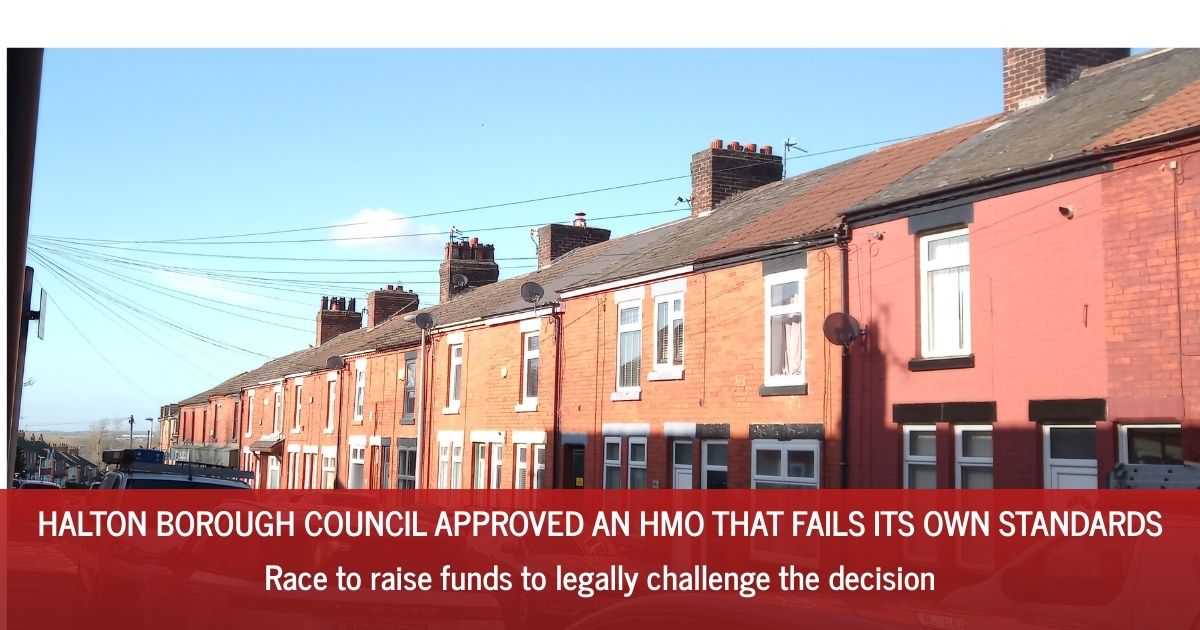
Funds have not been reached and time is running out.
I have had cash pledges of support, and I’m really grateful. Now I need to turn that support into funds to move this forward.
A Letter Before Claim was issued to Halton Borough Council on 06/04/2026. They must respond by 13/04/2026.
If this is not resolved, I will be submitting to the court for permission for Judicial Review.
A barrister has confirmed there is an arguable case.
I cannot afford legal representation, so I will be self-representing to take this forward.
If you believe this decision should be properly challenged, please donate if you can.
Every amount helps towards the court fees.
If you can’t donate, please share this page and the fundraiser.
What happened
A two bedroom terraced house in Runcorn was granted planning permission to convert into a four bedroom House in Multiple Occupation.
This approval was made by Halton Borough Council shortly after Article 4 planning controls came into force in February 2026. The application appears to be the first HMO proposal to go through the new full planning scrutiny required under those controls.
Why challenge this decision
Halton introduced Article 4 planning controls so that small HMOs (3–6 occupants) could no longer be created automatically. They must now go through planning and be checked against the council’s own HMO standards.
Those standards are set out in Halton Borough Council’s Houses in Multiple Occupation Supplementary Planning Document (March 2025). They include minimum bedroom sizes, communal space requirements and guidance on whether a property is suitable to operate as an HMO.
Halton Borough Council approved an HMO that fails its own standards. If HBC will not enforce the rules it wrote, who will?
If you agree this decision should be challenged, help fund the legal review and share this page so other residents can see what has happened.
The Halton HMO Supplementary Planning Document sets a benchmark communal living space of 17.5m² for a five occupant HMO.
Scaled for four occupants this equates to roughly 14m² for the main communal room.
What the standard expects
Main communal room benchmark17.5m²
Scaled comparison (4 occupants)≈14m²
If the communal room is smallerSecond communal room required
Minimum second communal room13m²
What was approved
Dining room used as communal room12.2m²
Kitchen cited as second communal space8.35m²
Required additional communal room if main room below standard13m² minimum
Relevant wording from the Halton HMO Supplementary Planning Document:
"Where communal areas are provided in addition to the rooms used for sleeping the space standards for communal areas are 17.5m² based on a 5 bed HMO."
"If this cannot be provided in a single room an additional communal room of a minimum 13m² must be provided."
How the planning permission was approved
The officer report to the Development Management Committee treated the kitchen and dining room as additive communal space. This reasoning appears in the committee report under section 6.2 "Design, Scale and Layout".
In effect, the floor area of the kitchen and dining room was combined to demonstrate that sufficient communal space existed.
However, Halton's HMO amenity standards treat kitchens and communal living rooms as separate requirements. Kitchens have their own minimum standards, while communal living space is expected to be provided as a dedicated shared room.
The committee report explaining this interpretation was not available on the public planning portal before the meeting. As a result, objections focused on the absence of a second communal room rather than how communal space had been assessed.
If this interpretation is accepted, other planning applicants could use the same reasoning to approve HMOs in properties that are not suitable. That could affect future decisions across Article 4 wards in Halton.
The Article 4 Direction was introduced by Halton Borough Council to remove permitted development rights for small HMOs in specific wards. This means proposals for smaller HMOs must go through the full planning application process rather than being created automatically through permitted development.
The direction was issued by Executive Board and later confirmed following consultation, coming fully into force in February 2026.
Areas affected
The Article 4 Direction means small HMOs in the following Halton wards must now go through the full planning process rather than relying on permitted development.
This planning decision could affect housing standards across Halton. Sharing this page helps more residents see what has happened and understand why it matters.
Residents across Halton need to see this planning decision. Copy the message below and share it in local Facebook groups, WhatsApp groups or community forums.
An Article 4 Direction is a legal mechanism used by local planning authorities to remove permitted development rights in a defined area. In Halton, it removes the automatic right to convert a dwellinghouse (Use Class C3) into a small House in Multiple Occupation (Use Class C4), meaning planning permission is required.
Before the Article 4 Direction, converting a house into a small HMO was often permitted development, so no formal planning application was needed. Halton Borough Council introduced the Direction to gain greater control over the number and location of HMOs because of concerns about clustering and its impact on local character and community cohesion.
Halton Borough Council approved an immediate Article 4 Direction which came into effect on 24 September 2025. It was later formally confirmed by the Executive Board in February 2026.
The Article 4 Direction applies in these Halton wards: Appleton, Beechwood & Heath, Bridgewater, Central & West Bank, Grange, Halebank, Halton Castle, Halton Lea, Mersey & Weston, Norton North, and Norton South & Preston Brook.
The Article 4 Direction itself does not set room sizes. It is the legal mechanism that requires a planning application. Once that application is made, the proposal can be assessed against Halton Borough Council’s Houses in Multiple Occupation Supplementary Planning Document and HMO Licensing Requirements, which include minimum space standards for bedrooms and communal areas.